The following is a “Mystery Review” where one of the writers is presented with a random game with no context. The writer is not allowed to view any media or commentary related to the game during gameplay or the review process. This is an experiment to see how our preconceived notions of games may influence our enjoyment of them, as well as the review process.
I’m one of those people who enjoys difficult games, partly because I relish a worthy challenge. Some people like watching others struggle against hardcore games, whereas I want to get involved for myself. Dark Souls and Celeste are two of my favorite titles of all time, so difficulty isn’t generally something that turns me off. Stealth Blade, on the other hand, is a PC game I enjoyed until it became something that I would rather watch than play.
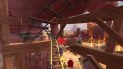
When you start Stealth Blade, you are greeted with a snappy intro cinematic that pulls you into the action very quickly. This is a classic side-scrolling action platformer, with a control scheme that feels largely geared for a mobile release. You have four abilities: a double jump, (that is hopefully self-explanatory,) a shuriken throw, disguise, and a dash strike.

The objective of Stealth Blade is simply to reach the other side of the level and collect scrolls along the way. By gathering enough scrolls, you will be able to progress to the next zone. These scrolls are sometimes hidden or located in hard-to-reach places and will often require a bit of combat or platforming technique if they are to be acquired.

When it comes to combat, your shuriken is your main weapon. It allows you to take down enemies from a safe distance, which is important because you die in one hit. This can sometimes be tricky because there are enemies with shields who can deflect your frontal assaults. Projectiles aside, I figured out that the “I win button” can be found using your dash strike. The dash strike cannot be used constantly, but its cooldown can be improved by upgrading it with gold you gain along the way. The final trick up your ninja sleeves is a decoy move, allowing you to make yourself unidentifiable to enemies, often allowing you to sneak past or attack them from behind.

All of these abilities need to be used effectively on account of one very crucial aspect of the game. As I mentioned earlier, in Stealth Blade you die in one hit. If you die, you are sent back to the last checkpoint you crossed. The checkpoints in this game do not feel very fairly placed, often leading to you redoing long swaths of platforming you already crossed many minutes ago. If you die too many times on the same level, you will have to restart from the beginning or pay a gold fee to continue from where you are. This system is reminiscent of old-school games like Mario and Sonic and feels a bit tacked on. It can also be a nuisance because there is a variety of ways you can get murdered.

The hazards in Stealth Blade are the part that compelled me to throw objects in my room. Spike traps will activate with little warning, large boulders will appear to crush you, and the platforming can feel a bit wonky at times. Aside from the multiple death traps, the most annoying hazard in the game is fire. This definitely isn’t Dark Souls and a bonfire is a hazard that kills you immediately. Considering setting yourself ablaze isn’t ever a very smart move this makes total sense. A poorly placed torch will also kill you. This is obviously for the same reasons but unless you’re a particularly flammable ninja, this makes less sense. It’s especially frustrating when the killer torch is placed on the side of the building you are supposed to climb. It does not feel like a challenge to my platforming abilities, it feels like a cheap shot that sends me back to a distant checkpoint.

The simple but largely irritating aspect of the core gameplay that we’ve just discussed is what soured the experience for me. Alongside this fact, the game features very little original gameplay and heavily reuses its creative assets. Sadly, Stealth Blade does not introduce any new mechanics or enemies beyond the first few stages that elevate the gameplay into something more engaging. On account of this title’s flaws, the gameplay felt like a chore after the fourth level. There are upgrades for your abilities, but they all feel rather hollow and are simply uninteresting. There are not many bugs to speak of, but the game feels like a glitch in design instead. I applaud the developer for finishing the game, but unfortunately finishing the game myself felt more like an act of frustration.
This review was based on a copy of the game provided by the publisher
Stealth Blade
-
Art Style 7.5/107.5/10
-
Gameplay 5/105/10
-
Audio 6.5/106.5/10
-
Replayability 5/105/10
Not quite hitting the target
Stealth Blade is a basic action platformer that succeeds in being just that. It does not try to be anything more than what it is and what it does is fairly mediocre. Nothing is noticeably broken or glaring off, but the game does not have any real appeal after the first four levels. It is missing a spark that could elevate this game into something much more enjoyable.